
Brick-Mortar-Cloud Podcast
Season 2 Episode 10:
Branding, Failure & Scaling F&B the Hard Way with Tommy Pang
Today, we sit down with Tommy, a second-generation F&B entrepreneur who has grown far beyond his hawker roots. From helping his parents at a single stall to building a portfolio of over 20 outlets across multiple brands, Tommy’s journey is one of grit, experimentation, and hard-earned lessons.
In this conversation, Tommy opens up about scaling too fast, rebuilding after costly mistakes, and why branding, systems, and people matter just as much as food. He shares how concepts like Hae Claypot, Shen Yan, and other emerging brands came to life, along with the realities of labour costs, marketing, and surviving in one of the toughest industries in Singapore.
Below is the full transcript of our conversation. If you’re an F&B founder, operator, or anyone curious about what really goes on behind the scenes of scaling food businesses, this is a story worth digging into.
Watch the video here now!
Prefer listening? We got you covered!
Read the transcript here!
🎙️ Brick Mortar Cloud Podcast with Tommy Pang (F&B Entrepreneur, Hey Claypot Group)
Host:
Welcome to the Brick Mortar Cloud podcast, where we share scaling stories of F&B and retail businesses. This podcast is brought to you by StaffAny. Today, I’m super excited to have with me Tommy Pang from Hae Claypot. Hi Tommy, welcome to the show.
Tommy:
Hi, nice to meet you. Thanks for having me.
Host:
Tommy, you’ve been involved in many businesses across the F&B industry. Can you share a bit more about your background and how you got started?
Tommy:
Sure. I’ve been in the F&B industry for about 10 years now, although I didn’t intentionally choose it at the start. My parents were hawkers, and none of my siblings wanted to take over the business. So I decided to step in to help them out and learn the ropes.
Over the years, we’ve grown to multiple brands. It started with my parents’ original brand, Pioneer, then Shen Yan, Hey Claypot, Hey Mee, a porridge brand called Pan Jia Zhou, and an upcoming claypot brand. Along the way, I also tried many other F&B ventures that didn’t go well, like opening a chicken rice restaurant when I was 21. I don’t see those as failures, but as lessons.
Host:
One of the brands that people are very familiar with today is Hey Claypot. How did that concept come about?
Tommy:
We weren’t the first to do claypot seafood. I remember visiting another brand’s opening at an industrial coffee shop. It was packed, and I went behind to talk to their staff to understand the sales figures. That night, they were doing high five-figure revenue, and I was shocked.
I went back and told my team that we had to try this concept. I felt that we could do better in terms of food quality, service, and branding. So within a month, we launched Hey Claypot.
At the start, we chose industrial coffee shops because rent was cheap, but there was no walk-in traffic. That meant we had to rely heavily on marketing. We doubled down on food quality, service, and branding, and spent a lot of time pushing marketing to make it go viral.
I honestly thought it would last only three months because I saw it as a trend. But surprisingly, it sustained itself, which told me that the concept had legs beyond just hype.
Host:
Even though you weren’t the first mover, Hey Claypot managed to stand out. How did you approach branding and differentiation?
Tommy:
We studied what competitors were doing, especially online. Were they running ads? Working with influencers? Then we asked ourselves how we could do more.
Branding was very important to us, from the name to the colors and logo. The word “Hey” was chosen because it’s catchy and friendly. We also saw it as a brand that could eventually go beyond just claypot, which later became true with Hey Mee.
We invested heavily in influencer marketing. Over the years, we built a large list of influencers and invited them to eat without forcing deliverables. We were confident in our food, and most of them naturally posted about it.
Host:
Did you come from a marketing background, or did you learn all of this along the way?
Tommy:
I learned everything the hard way. My background was actually in banking and finance. When I was 21, I opened a restaurant with my cousin. We lost money every month for the first year, and my parents had to support me.
When I first joined my family’s business at 18, all I did was dishwashing, taking orders, and simple cooking. I felt like I wasn’t adding value. I even asked my dad if I should go to culinary school, but he told me that learning how to run a business was more important than learning how to cook.
That advice really shaped how I approach F&B today.
Host:
How big is the business today, and what are your plans going forward?
Tommy:
Currently, we have about 23 outlets and six brands. Our focus now is building strong, long-term brands that people can eat regularly, not trend-based concepts.
We’re also developing new concepts like claypot rice, using technology to shorten cooking time while keeping traditional flavors. There’s also an upcoming Cantonese restaurant, but I’ll keep that under wraps for now.
Host:
Hiring and retaining staff is one of the toughest parts of F&B. How do you manage that?
Tommy:
It’s very tough. The salary must be competitive because the work environment is challenging. People stand in small, hot spaces for long hours.
In most stalls, only two or three people work together, so their relationship is extremely important. They spend more time with each other than with their families. You need to take care of both their emotional needs and their income.
Host:
You’ve operated across hawker centres, coffee shops, industrial canteens, and food courts. How do these business models differ?
Tommy:
Each model has pros and cons. Hawker centres have foot traffic but intense competition. Industrial canteens have almost no walk-in traffic, so marketing is critical. Food courts allow us to test concepts cheaply using our own spaces.
Recently, I’ve been exploring smaller mall spaces as well. I’ve always preferred lower rents, but I think it’s time to try something slightly more premium.
Host:
You’ve also experienced failures, especially during rapid expansion. Can you share one of the toughest lessons?
Tommy:
One of the biggest lessons was expanding too fast with Shen Yan. At one point, I had over 40 outlets. I partnered with people through joint ventures, but I didn’t set the right systems or do proper background checks.
When money started coming in, some partners took it for granted. Mismanagement happened, and eventually things fell apart, especially during COVID. I learned that not everyone is suited to be a business owner.
Today, I’m much more grounded. I focus on building foundations before scaling again.
Host:
What would you do differently if you were to try that expansion model again?
Tommy:
I would slow down, build stronger systems, and be more selective with partners. Expansion without structure is dangerous. I was chasing speed and recognition instead of sustainability.
Host:
What advice would you give to aspiring F&B entrepreneurs?
Tommy:
F&B is extremely tough. If your goal is just to make money, don’t do F&B. But if you have passion and perseverance, just remember this: you only need to get it right once. Don’t give up.
Host:
Before we end, a quick rapid-fire round. Who is someone you learn the most from?
Tommy:
My dad.
Host:
If someone wants to follow your journey, where can they find you?
Tommy:
You can follow me on Instagram at @tommybong96.
Host:
Final words for our listeners?
Tommy:
To all F&B entrepreneurs out there, stay strong and never give up. One day, you’ll see the light at the end of the tunnel.
Host:
Thank you so much, Tommy. That was an amazing conversation.
Tommy:
Thank you. Appreciate it.
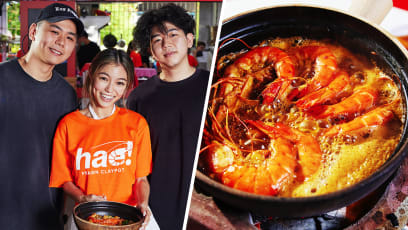
Tommy Pang is a second-generation F&B entrepreneur who grew up in the hawker trade and learned the business from the ground up. What started as helping his parents at a single stall evolved into building and operating multiple food concepts across Singapore. Over the years, Tommy has launched and scaled brands such as Hey Claypot, Shen Yan, Hey Mee, and other emerging concepts, experimenting across hawker centres, coffee shops, industrial canteens, and food courts.
Through both rapid expansion and painful setbacks, Tommy’s journey is shaped by hard lessons in branding, systems, and people. Today, his focus is on building sustainable, long-term food brands that balance tradition with modern operations, proving that growth in F&B is not just about speed, but about foundations that last.